

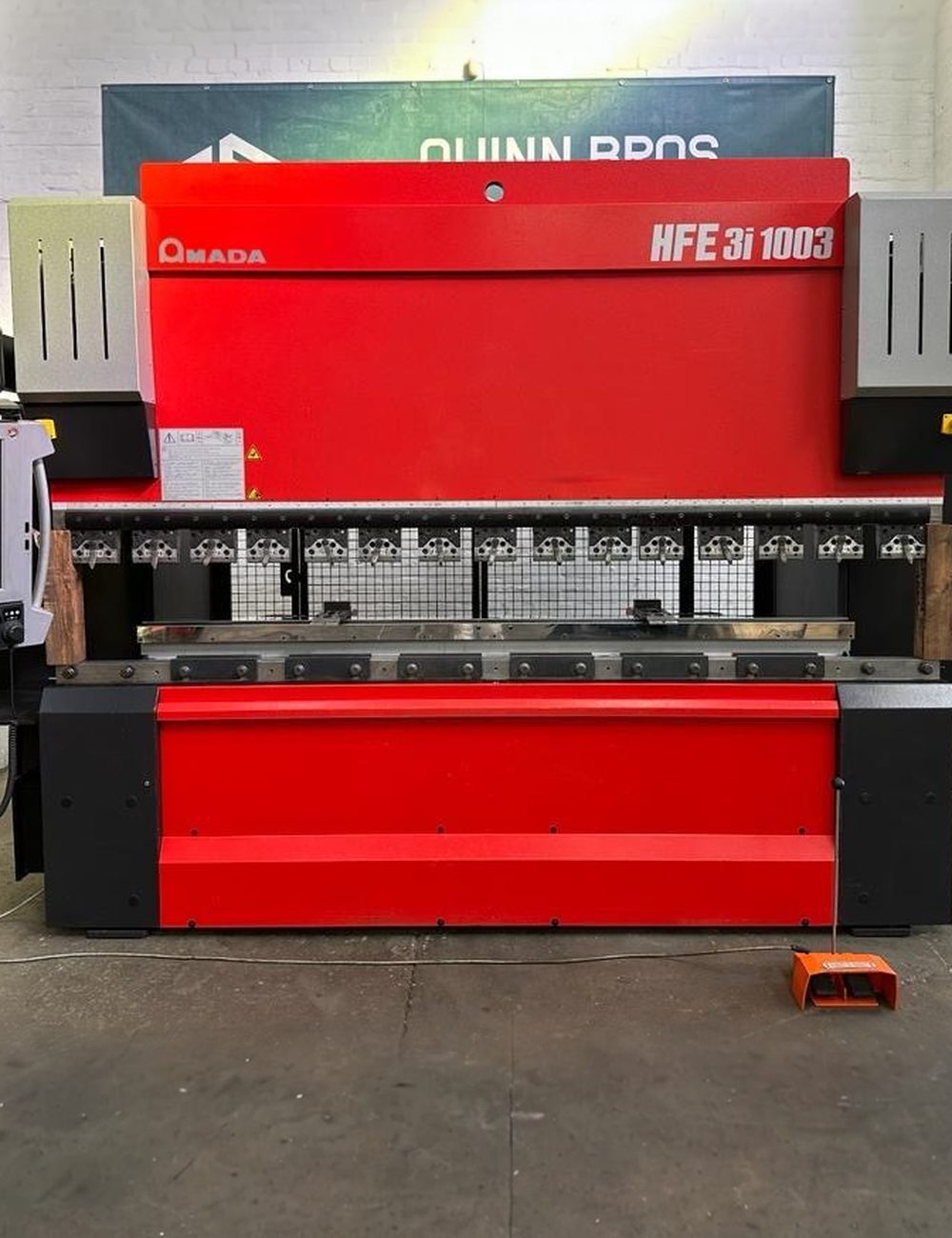
Used Amada Press Brakes For Sale
Amada is the press brake most UK fabricators ask for by name. Every used Amada press brake we have for sale is on this page, run and checked under power at our warehouse in Cradley Heath, twenty miles from Amada UK's own technical centre at Kidderminster.
Below the stock: how the generations differ, which control you are looking at, and which family suits the work you do.
Amada In Stock
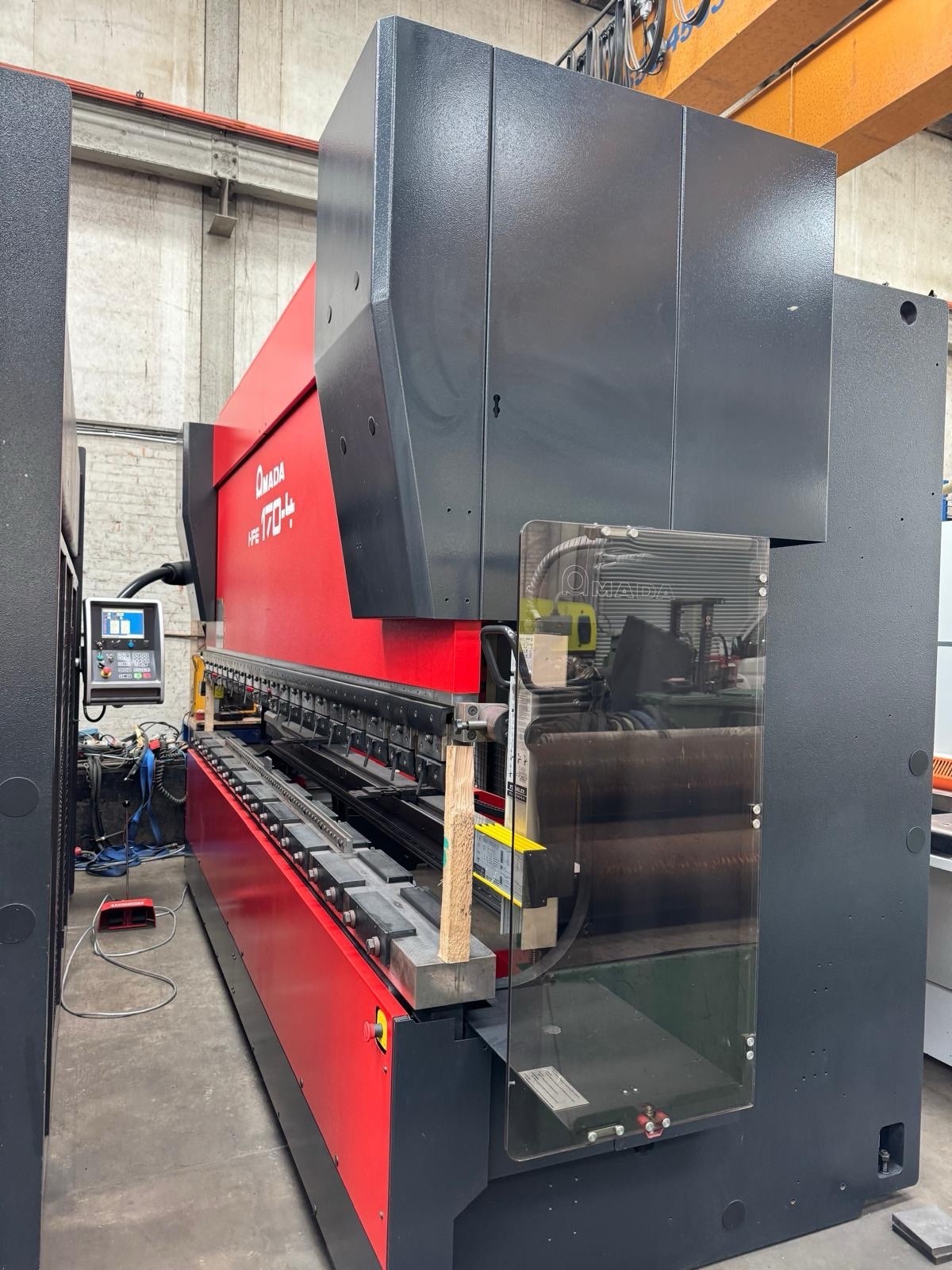 New Listing
Amada Promecam ITPS 100 30 CNC Hydraulic Press Brake
- Brand
- Amada Promecam
- Price
- POA
- Stock Ref
- 2104
Amada Promecam ITS2 125 30 7 Axis CNC Press Brake
- Brand
- Amada Promecam
- Price
- POA
- Stock Ref
- 2032
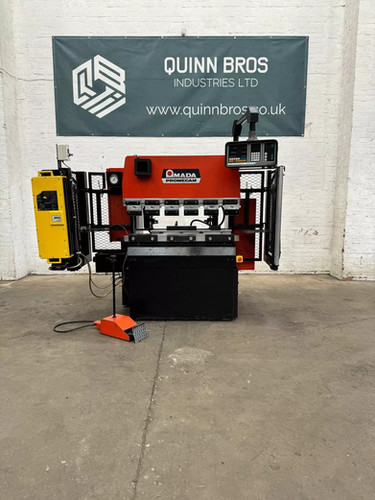
Amada Promecam IT2 2512 CNC Hydraulic Press Brake
- Brand
- Amada Promecam
- Price
- POA
- Stock Ref
- 2008
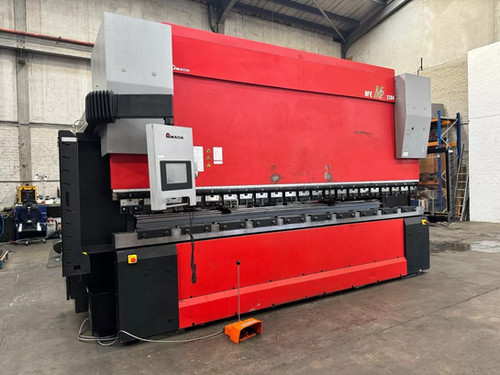
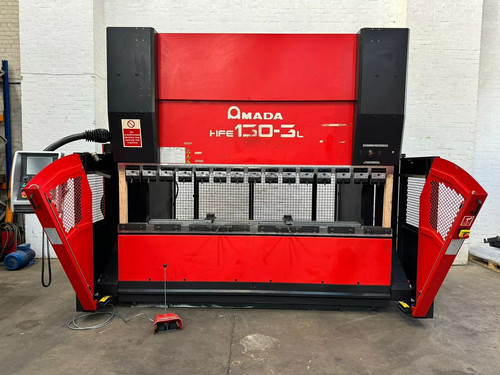
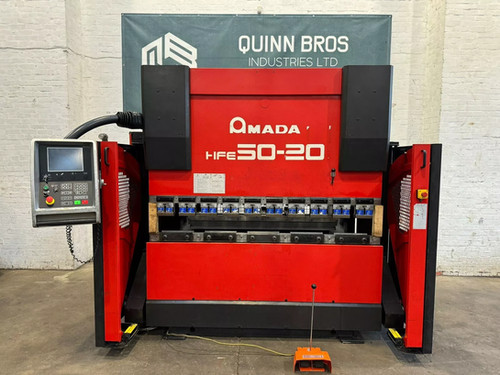
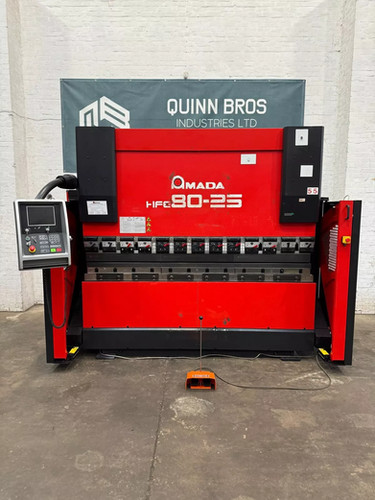
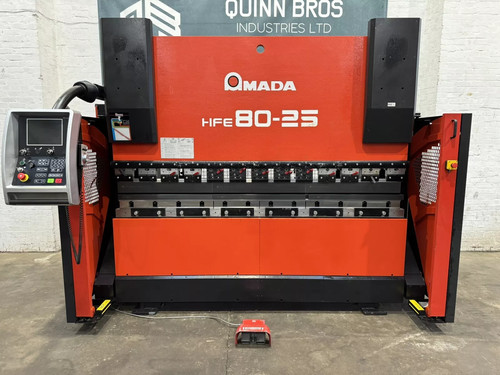
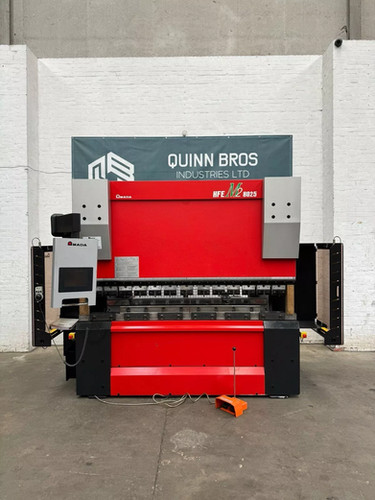
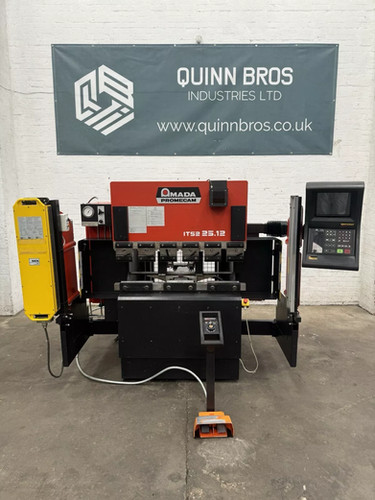
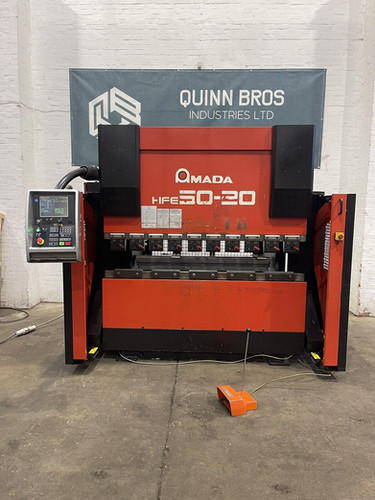
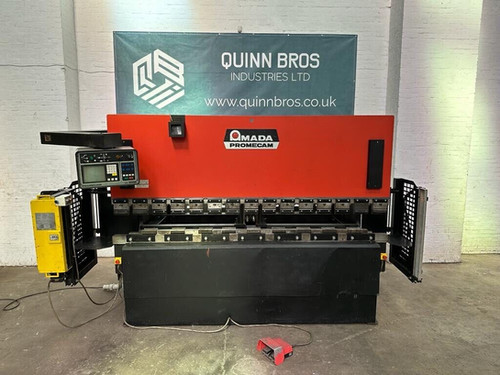
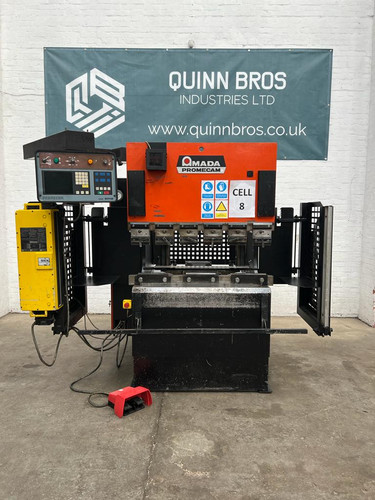
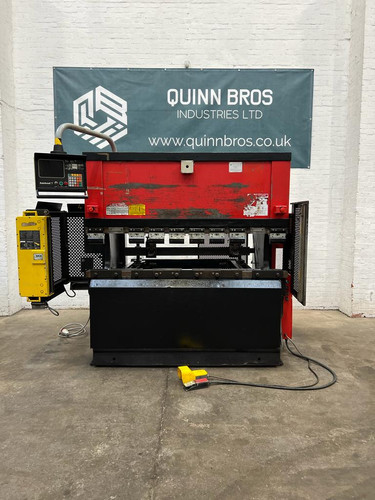
Amada Promecam ITPS 5012 Hydraulic Press Brake
- Brand
- Amada Promecam
- Price
- POA
- Stock Ref
- 1848
Not seeing it? We source to order. Tell us the tonnage, length and control you need on 01384 638 379 or send us the details.
Up-Stroking Or Down-Stroking
Also written up-acting and down-acting. The two pairs of words mean the same thing and both turn up in listings.
- Up-stroking, where the table rises. RG, RG-M2, FBD and the Promecam ITS, ITS2, ITPS and IT2 machines. The hydraulics sit low down so maintenance is easier and the machine is shorter overall. Your part lifts during the approach, so it needs a firmer hold. Tonnage is capped at roughly 125 to 140 tonnes.
- Down-stroking, where the ram comes down. HFB, HFE, HFT, HFP, HFE M2, HFE3i, HD, HDS, HS, HG, HRB and the electric machines. This is how Amada got past 140 tonnes and up to 400.
If you have only run a down-stroking machine, an up-stroking RG or ITS will feel different. It is not worse, it is a different habit.
Promecam ITS, ITPS & IT2
The original French machines, badged Amada Promecam after 1986. Hydraulic, up-stroking, roughly 25 to 125 tonnes, with the optional Promecam MB control or a Cybelec. The naming uses a dot, so an ITS2 50.20 is 50 tonne by 2000 mm. Simple, heavy, and still working in plenty of UK shops.
Who It Suits
- Repeat work. Brackets, flanges, simple boxes, a shop bending the same handful of parts week in week out. These machines were built for that and they still do it.
- A first press brake, or a second one. Simple enough that anybody can be shown how to run it, and cheap enough to take pressure off a bigger machine.
- Anyone watching tooling costs. Promecam style became the European standard, so punches and dies come from a dozen makers rather than one.
Amada Promecam ITPS 100 30 CNC Hydraulic Press Brake
- Brand
- Amada Promecam
- Price
- POA
- Stock Ref
- 2104
Amada Promecam ITS2 125 30 7 Axis CNC Press Brake
- Brand
- Amada Promecam
- Price
- POA
- Stock Ref
- 2032
Amada Promecam IT2 2512 CNC Hydraulic Press Brake
- Brand
- Amada Promecam
- Price
- POA
- Stock Ref
- 2008
Amada Promecam ITPS 5012 Hydraulic Press Brake
- Brand
- Amada Promecam
- Price
- POA
- Stock Ref
- 1848
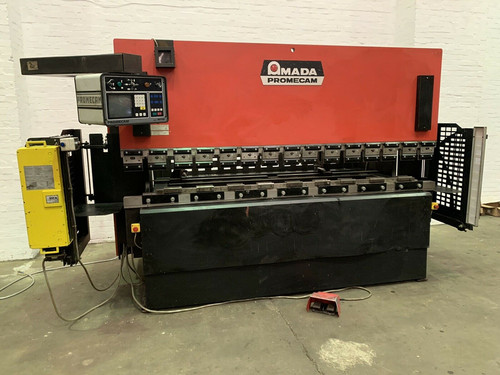 Sold
Sold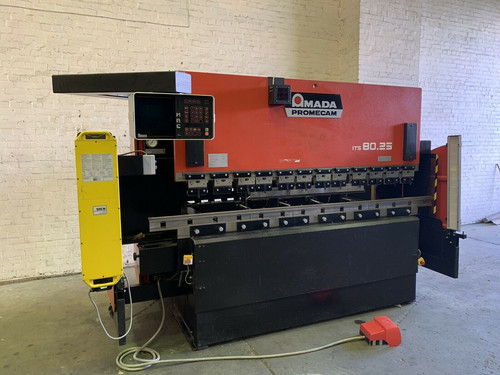 Sold
SoldRG Series
Amada's first press brake family and one of the most common used machines in Britain. Hydraulic, up-stroking, 25 to 125 tonnes, running AutoBend 7, then NC9-EX, then NC9-EXII. The RG-M2 is the modern successor, still sold new by Amada India and still up-stroking.
Who It Suits
- A shop moving from manual to CNC. Three axes, straightforward to learn, and the machine does not punish an operator who is still finding their feet.
- Anyone who wants a machine other people understand. The RG is one of the most common press brakes in Britain, so engineers know it and parts turn up.
- 25 to 125 tonnes, hydraulic and up-stroking.
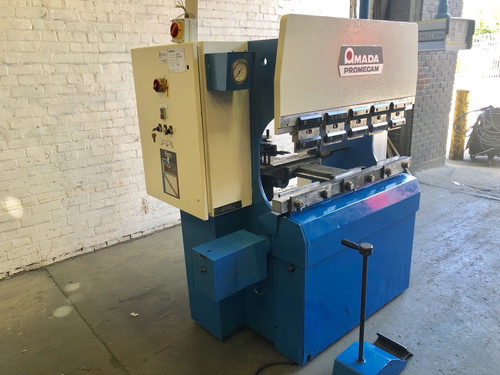 Sold
SoldAmada Promecam CNC Hydraulic Press Brake RG2512
- Brand
- Amada Promecam
- Price
- POA
- Stock Ref
- 1146
HFB & HFBO
The first big down-stroking Amada Promecam machines, from 50 tonnes right up to 630, with a 630 tonne by 8.1 metre HFBO on record. Backgauge to eight axes. The control is the Operateur, then Operateur OP2 with a 12 inch colour screen, then Operateur OPE II with a 14 inch colour TFT on later HFBOs.
You will also see HFBs running Delem DA58 or DA66W controls. Those are almost always retrofits, and on a machine of this age a retrofit is a good thing rather than a warning.
Who It Suits
- Heavy plate and long beds. This is where Amada put the tonnage before the modern range: 50 tonnes up to 630, and lengths to 8.1 metres.
- Complex parts. Backgauge to eight axes, so tapered flanges, deep boxes and awkward returns are all in reach.
- A shop with the floor for it. Check the slab and the power supply before the budget on anything at the top of this range.
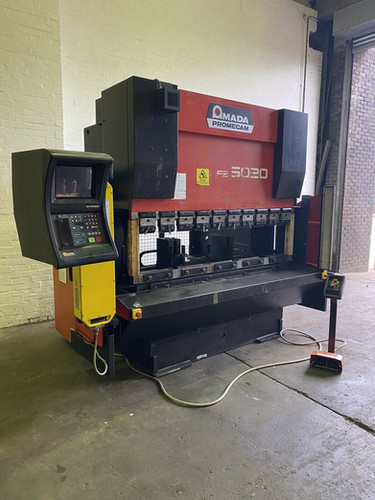 Sold
SoldHFE Series
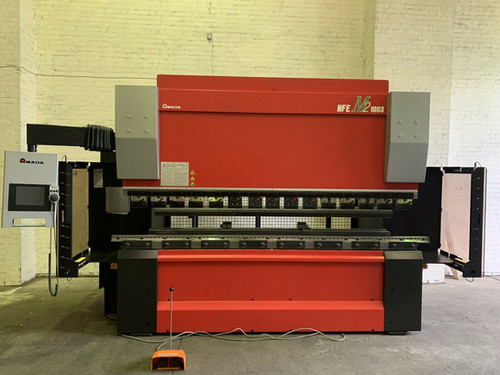
The workhorse. When somebody says an Amada press brake without giving a model, this is usually the machine they picture. 50 to 220 tonnes, 2 to 6 metres, with five backgauge axes as standard: X1, X2, R, Z1 and Z2.
The control is the Operateur 2000, often written OP 2000, and it was a real step forward. It draws the profile in 2D, works out the developed length, the bend sequence and the backgauge positions, and checks for collisions. The HFE also uses Amada's patented parallel deflection lower beam, which is covered under crowning below.
Who It Suits
- Most fabrication shops. This is the default choice and the machine most people mean when they say they want an Amada. 50 to 220 tonnes, 2 to 6 metres.
- Mixed batch work. Five backgauge axes as standard, which is more than most machines of the period, so setups change without anyone walking round the machine.
- Anyone programming from a drawing. The Operateur 2000 draws the profile, works out the developed length and the bend sequence, and checks for collisions before the ram moves.
- Deep box work: ask for an L or SL. Long stroke gives 620 mm open height and 350 mm stroke instead of 470 and 200. It is the difference between doing deep boxes and not doing them.
New ListingHFE M2
The HFE M2 is largely the same machine as the HFE. An HFE 100-3 and an HFE-1003 M2 share the same 3110 mm beam, the same 200 mm stroke and near-identical weight.
- The AB-Pad touchscreen replaced the Operateur 2000.
- An ECO start/stop drive shuts the pump down between cycles.
- The range gained the 5012, 50 tonne by 1.27 metre.
- Backgauge is 2 axes or 5, with Amada's Delta X option.
Later machines carry the AB-Pad Evolution control, and there is an EVO sub-variant from around 2017. The HFE M2 is still sold new in 2026 and has not been discontinued.
Who It Suits
- The same work as an HFE, with a modern screen. The frame is the HFE's, so the machine handles identically. What you are paying the difference for is the AB-Pad touchscreen and an ECO drive that shuts the pump down between cycles.
- Anyone who wants trial bends gone. The AB-Pad pairs with the Digipro wireless angle gauge: measure the bend by hand and the control corrects itself.
- Tapered and non-parallel parts, where Delta X is fitted. Two independent X axes. It is an option rather than standard, so ask.
- Still sold new in 2026, so parts and support are current rather than legacy.
 Sold
SoldAmada In Detail
Controls
Amada ran two separate control lineages for decades, because it had two separate factories.
- Japanese line, on RG, FBD, HD, HDS, HG and HRB: AutoBend 7, NC9-EX, NC9-EXII, the LD and NT controls, AMNC, AMNC-PC, AMNC 3i, AMNC 4ie.
- European line, on the Promecam-heritage machines ITS, HFB, HFE, HFT and HFE M2: MB, Operateur, Operateur OP2, Operateur OPE II, Operateur 2000, AB Pad, AB Pad Evolution.
The HFP and the HFE3i cross over to the Japanese AMNC line.
Control By Control
| Control | Machines | What it does |
|---|---|---|
| MB | Promecam ITS, ITPS | Optional NC. Alphanumeric, not graphical. 1 to 4 axes, nine programs, 81 steps. Backup by EPROM cartridge. |
| NC9-EX, NC9-EXII | RG, FBD, 1984 to 2000 | 3-axis keypad control. The classic legacy Amada control. |
| Operateur, OP2, OPE II | HFB, HFBO, HFT | 12 inch colour on OP2, 14 inch colour TFT on the later OPE II. |
| Operateur 2000 | HFE | 2D profile drawing, automatic developed length, bend sequence, collision detection, 3D offline simulation. |
| CD 2000, 2001, 2005 | HFT | The straightforward 4-axis control. |
| AMNC, AMNC-PC | HFP, HD, HDS, FBD-NT, HS | Touchscreen. Imports DXF, DWG and IGES in 3D. Storage unlimited over the network. |
| AB Pad, AB Pad Evolution | HFE M2, HS | Touchscreen, still current. Works with the Digipro wireless angle gauge. |
| AMNC 3i | HFE3i, HG, HRB, EG, SRB, ATC machines | 18.5 inch vertical multi-touch. Direct, angle, 2D and 3D programming, and a Lite mode. |
| AMNC 4ie | EGB-e, 2024 on | Tablet on an overhead track, augmented reality overlay, voice command, operator face recognition. |
Program Transfer
This is the biggest practical headache on an older Amada and almost no listing mentions it.
- Legacy machines use 1.44 MB or 720 kB floppy drives. USB floppy emulators are made specifically for HFB, HFBO and older HFE machines, and they work well.
- Some HFE machines hold only around 60 programs on the control and on the stick, and will accept only the USB stick supplied by the Amada dealer. Identically formatted aftermarket sticks get rejected.
- From AMNC-PC onwards storage is unlimited over the network, and by AMNC 3i programs live in a networked database.
- Amada's own answer for older machines is FabriTALK for BEND, a Windows package that puts a legacy brake on a network with graphical bend sequence display.
Ask us about this before you buy and we will tell you what a given machine can and cannot do.
Delem And Cybelec
You will see Amada machines advertised with Delem or Cybelec controls. On the European HFB and Promecam machines these are usually retrofits, and they are a good thing. A Delem DA-56, DA-66T or a ModEva is a modern, well supported control with parts and training freely available. Retrofit is a mature market for Amada, and specialists rework RG, FBD, HFB and Promecam machines as standard work.
Backgauge Axes
| Axis | What it does |
|---|---|
| Y1, Y2 | The ram coming down. Two cylinders controlled separately so the beam stays parallel and the angle is the same at both ends. |
| X | How far back the stops sit. This sets your flange length. |
| X1, X2 | Each finger to a different depth, for tapered or angled edges. |
| Delta X | Amada's name for the two-independent-X option. |
| R | Stop height. Needed for deep boxes, returns and flanges that would otherwise foul the gauge. |
| Z1, Z2 | Fingers sliding along the beam. Motorised Z means the operator is not walking round to move stops by hand. |
- Two axes, Y and X. Fine for simple repeat flanges.
- Motorised R. The first thing you miss on box work.
- Motorised Z1 and Z2. The biggest labour saver on mixed batches.
- Delta X or X1 and X2. Only earns its keep on tapered and non-parallel parts.
Dealers count axes differently. The same machine is advertised as 5 axis by one seller and 7 axis by another, depending on whether the two ram cylinders are counted. We publish the full axis list on every machine we sell.
Crowning
Under load the ram and the bed both bow away from each other in the middle. Without correction the middle of a long bend comes out at a more open angle than the ends. Crowning cancels that out. Amada solves it several ways depending on the machine.
| Approach | Machines | How it works |
|---|---|---|
| Natural, parallel deflection | HFE, HFE M2, HFE3i | The upper and lower beams are built to bend together, so the gap between them stays the same. |
| Variable slit crowning | HD | Standard fit. |
| Active hydraulic crowning | HG, HG-ATC | Corrects the upper beam in real time as it deflects. |
| Auto crowning | HRB | Servo auto-crowning on top of natural crowning. |
| Electric asymmetric | EGB-e | Different correction left and right, so the beam stays parallel bending off-centre. |
Crowning On An HFE
On the HFE family there is no crowning axis and no crowning cylinder, because Amada's patented parallel deflection beam does the job passively. It is not missing and it is not broken. Amada still uses the same design on machines it sells new today.
Angle Measurement
- Bi-S. Mechanical contact probe, one or two axis, double sided. Works from 90 to 165 degrees and 1 to 6 mm thick. Measures springback and corrects the next stroke, so there is no trial bending.
- Bi-L. Laser, offered alongside Bi-S on HD generation machines.
- Bi-M. Laser, an HFE3i option, with real time correction.
- Digipro. A wireless hand-held protractor. The operator measures the bend, the reading goes to the control by radio and the control adjusts the program itself. On the HFE M2 and HFE3i.
An angle measuring system on a used machine is worth real money. It removes trial bends, which is where scrap comes from.
Tooling
Because Amada bought Promecam, Promecam's tooling geometry became the European standard. Promecam style, Euro style, European style and Amada style all mean the same tooling.
| System | Tang | Grooves | Setup |
|---|---|---|---|
| American, old New Standard | ½ inch, flat | None | 5 to 15 min |
| European, Amada Promecam | nominally 13 mm | One, at the rear | 2 to 5 min |
| Wila, Trumpf | 20 mm | Front and back | Under 1 min |
Amada does not publish its tang dimension. The 13 mm figure is the one quoted consistently by the independent tooling makers, so treat it as theirs rather than Amada's.
- You are not locked into Amada-branded tooling. Amada and Promecam style is a de facto standard. Rolleri, Precitools, CAD Technologies and others all build to it.
- Amada style will not fit a Wila or Trumpf machine. 13 mm tang against 20, one groove against two. Moving from a Trumpf to an Amada, the tooling does not come with you.
- Watch the words New Standard. Wila sells a modern 20 mm range under that name. Some American suppliers use it to mean the old half inch tooling. Buyers get caught by this regularly.
- AFH is Amada Fixed Height, in 70, 90, 120 and 160 mm. Different profiles share one height so several sit side by side in one setup. It also means the laser guard is not re-taught at every tool change.
- S-Grip is worth finding. It holds both European style tooling and Amada's AFH, which makes a used machine materially more flexible.
Genuine Amada tooling is laser etched with the type, angle, tonnage, length and radius. Check the marks are there and legible.
Choosing Tonnage
Pick the vee first. Amada's own published rule, from its bending tools catalogue:
| Material thickness | Recommended vee |
|---|---|
| 0 to 3 mm | 6 × thickness |
| 3 to 8 mm | 8 × thickness |
| 8 to 12 mm | 10 × thickness |
| Over 12 mm | 12 × thickness |
Then read the force. Amada's figures for mild steel, in kN per metre of bend:
| Thickness | V6 | V8 | V10 | V12 |
|---|---|---|---|---|
| 1.0 mm | 110 | 100 | 80 | 70 |
| 2.0 mm | 220 | 190 | 170 | 150 |
| 3.0 mm | 340 | 300 | 240 | n/a |
For other materials Amada's instruction is to use the mild steel figures and multiply by k = Rm / 450, where Rm is the tensile strength in N/mm². Mild steel is about 450 and stainless about 700.
Worked Example
2 mm mild steel, 2 metre bend, V10 die: 170 kN/m × 2 m = 340 kN, about 34 tonnes.
The same job in 304 stainless: k = 700 / 450 = 1.56, so 340 × 1.56 = 530 kN, about 53 tonnes. That is why a 50 tonne machine that handles your mild steel comfortably can struggle the moment stainless arrives.
- Your tooling has its own tonnage rating, usually lower than the machine's. Amada marks it on the tool.
- Short bends concentrate the load. Never apply full machine tonnage over a short centre length.
The Promecam Link
Amada did not design its own first press brake. In 1965 it signed a technical agreement with Promecam Sisson-Lehmann, a French builder that had been making press brakes since 1955, and began producing them under licence as the RG series. In 1986 Amada bought Promecam outright.
The French factory became Amada's European press brake plant and still builds them today at Montval-sur-Loir, the same commune as Promecam's old works. That is why older machines are badged Amada Promecam, why the standard European tooling is called Promecam style, and why Amada runs two separate control families, one Japanese and one European.
Amada UK was incorporated in 1972 and built its Kidderminster technical centre in 1986.
Looking For An Amada?
Tell us the tonnage, the length and the control. We buy them as well as sell them.